The Lancet 341:898
April 3, 1993Errors in predictions of the incidence and distribution of AIDS
SIR, - In their report for 1993,(1) the US National Research Council concludes that the AIDS epidemic in the USA is concentrated in a few well-defined groups: homosexuals, racial minorities, and intravenous drug users. This is belated recognition of a consistent epidemiological trend. Predictions made on this trend by regression of incidence over time for 1983-92 for the USA and for New York City are accurate to within 10% of registrations of annual and cumulative incidence.(2)
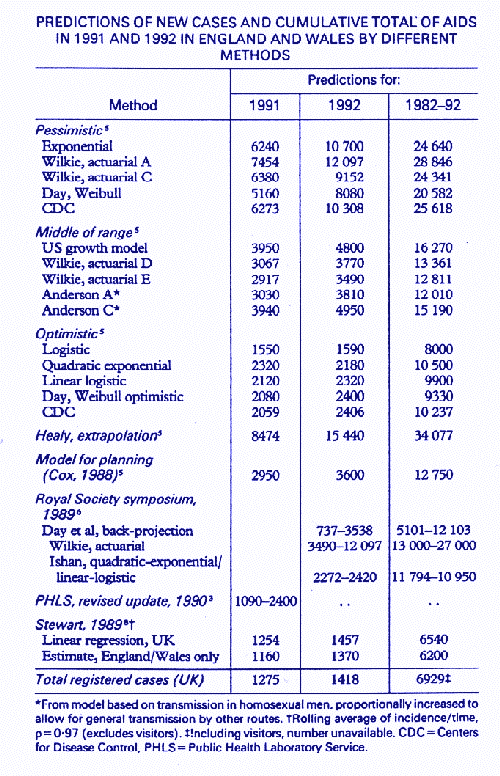
This is also true, though not explicitly admitted, in the UK where annual incidence for 1990-92 and cumulative totals are similarly predictable from regression lines (2) and back projection (3) from registration data (4) for 1983-89. The accuracy of prediction by these methods contrasts with the exaggeration in official predictions by the Cox Committee (5) and a panel of experts (6) convened by the Royal Society (table).
The discrepancies are explained largely by differences in assumptions about transmission. The erroneous predictions are all based on assumptions of heterosexual transmission of HIV in the general population. The lack of accurate or indeed any unbiased data on this in official surveillance means that mathematical models must use hypothetical analogies, sophisticated alternatives in rates, and wide confidence limits in prediction. Regression models succeed because correlation with time is consistent (p=0.97, 1983-89, moving average y= -34.7+10.1x) and assumptions of continuing spread in main risk groups is correct.
Further errors are caused because registration in the UK and internationally (7) give regional estimates and ignore denominators of relevant subsets of populations in risk groups and real locations. If returns for the UK are re-allocated on this basis, the extent of risk in vulnerable groups becomes apparent. For instance, the risk to homosexual-bisexual males who engage in anal intercourse in the high-risk subset of population in inner London, which accounts for more than 70% of all AIDS cases in the UK, is about 5000 times that of heterosexual engaging in risk behaviour and about 55000 times that of any adult or adolescent in the general heterosexual population. (8)
The UK Government is beginning to retreat from its pessimistic certainty (9) about pandemics of heterosexual transmitted AIDS. But the fact remains that policy, budgets, and prevention measures are generally based on these earlier predictions and on pressure from professional and activist groups to maintain or even increase the disproportionate amount of attention and ring-fenced budgets allocated to AIDS. This disparity will continue as long as epidemiologists are content to tolerate faulty data and methodology, and may be much worse in the third world where major confounding variables are ignored in returns compiled by the WHO and other agencies. (7,10) The disservice to the public, nationally and internationally, is twofold: constant exaggerations and alarm to huge majorities who are not at risk, and discounting and danger to minorities who choose or are driven to expose themselves directly and others indirectly to very high risks.
GORDON T. STEWART
Glenavon
Clifton Down
Bristol BS8 3HT, UK
1. McCarthy M. AIDS impact seen as small in the US. Lancet 1993; 341: 429-302. Stewart GT. Epidemiology and transmission of AIDS. Society of Public Health, Official Handbook 1992-93. London: Meadowbank Publishers, 1992.
3. Acquired Immuno Deficiency Syndrome (AIDS) in England and Whales to the end of 1993. Report of a working group convened by the Director of the Public Health Laboratory Service. London: PHLS, 1990.
4. Public Health Laboratory Service and Communicable Diseases (Scotland) Unit. AIDS/HIV Quaterly Surveillance Tables, 1983-92.
5. Department of Health and the Welsh Office. Short-term prediction of HIV infection and AIDS: report of a working group (Chairman, Sir David Cox). London: HMSO, 1988.
6. Cox DR, Anderson RM, Hillier HC, eds. Epidemiological and statistical aspects of the AIDS epidemic. Phil. Trans. R. Soc. London (B) 1989; 325: 37-187.
7. World Health Organization. Geneva: WHO. Weekly Epidemiol. Reports.
8. Stewart GT. AIDS in the UK: estimates of differences by risk-group denominators. Comm. Dis (Scotland) Weekly Reports 1991; 24 (AIDS suppl.): 1-3.
9. London Declaration on AIDS. The Times Jan 27, 1988.
10. World Health Organization Global Programme on AIDS. Current and future dimensions of the HIV/AIDS epidemic: a capsule summary. Geneva: WHO, 1992.