THE IATROGENIC NATURE OF AIDS
Statistical evidence from the CDC's dataBy Vladimir L. Koliadin
Oct. 1996
Expansion of surveillance definition of AIDS in late 1992 - early 1993 had resulted in abrupt change in the status of at least 36,000 individuals in the USA, mainly HIV-positives: they immediately fell into the category "AIDS-patients" without any objective changes in their health. This change in the status perfectly coincides in time with beginning of abnormal and significant rise in mortality rates in this group, which was 2-5 fold during about 1.5-2 years. It is essential that this upward trend in mortality is not associated with the time elapsed after diagnosis but only with the date of death itself. Such dynamics of mortality is abnormal for AIDS - the cases which meet pre-1993 definitions of AIDS exhibit a steady downward trend with a lapse of time after diagnosis. As far as CDC's data [1] are more or less reliable, the only plausible explanation of the phenomenon is that AIDS diagnosis itself causes drastic increase in mortality. At least two factors are likely to be responsible for this excessive mortality. First, severe side effects of the medication AIDS patients are usually put on. Second, detrimental psycho-physiological effect of severe and permanent stress resulted from the very information about diagnosis of AIDS.Introduction
The question addressed in this study has been: To what extent does AIDS diagnosis itself contribute to mortality of the patients?. Statistical analysis of the problem is seriously complicated by the ambiguous interpretation of the available data. Mortality of HIV-positives does increase dramatically after diagnosis of AIDS. It is widely believed that this phenomenon is a direct consequence of the severe nature of the syndrome named AIDS. On the other hand, there is a growing deal of concern, mainly among AIDS skeptics, that this drastic rise of mortality is caused by the AIDS diagnosis itself: mainly because of harmful medication of patients with AIDS diagnosis, and due to severe psychological stress (which results from the general belief in the AIDS=Death postulate). Both explanations of the fact that mortality rises many times after diagnosis of AIDS had been established seems to be plausible, at least from a logical standpoint. How to separate the effects of the two factors -- objective worsening of health and iatrogenic factors associated with diagnosis of AIDS (medication, psychological stress)?
A direct experimental test would have been to take two big groups of HIV-positives and to maintain one of them in double- blind: when neither patients nor physicians are aware about results of laboratory tests which are normally used to establish diagnosis of AIDS (counts of T4-lymphocytes, etc.). Individuals in this group should not be subjected to the medication AIDS patients are usually put on. Then, after several years of observation of the two groups, mortality might have been compared for those whose condition meets the current definition of AIDS. But such a study is hardly possible for ethical reasons.
The method used in this study is based on direct statistical analysis of CDC's data set [1]. Such a method of analysis was made possible only due to implementation of the new definition of AIDS in 1993 and inclusion of the individuals who meet only this new definition of AIDS (but not the earlier ones) in the data set with retrospectively established date of diagnosis (date when the condition was observed first).
Data
In December 1992 CDC published new surveillance definition of AIDS [2]. The official date of this "expansion of definition" is January 1, 1993. According to the CDC, "this expansion includes all HIV-infected adults and adolescents who have less than 200 CD4+ T-lymphocytes/microlitre or a CD4+ T-lymphocyte percent of total lymphocytes less than 14, or who have been diagnosed with pulmonary tuberculosis, invasive cervical cancer, or recurrent pneumonia" [2, p.9]. Thus, the new definition is based mainly on results of laboratory tests -- that for HIV (- antibodies) and for amount of T4-lymphocytes in peripheral blood.
The following peculiarity of the CDC's strategy in gathering statistics is essential to the question addressed in this paper. Besides the cases diagnosed since January 1993, about 36,000 cases which fit only the new 1993 definition had been diagnosed retrospectively and included in the official statistics with the date of diagnosis earlier than January 1, 1993. It is essential that the health condition of these individuals was not classified as AIDS until late 1992. In other words, these 36,000 individuals, whose condition met the new 1993 definition of AIDS, had been living without the AIDS-label for up to several years. In January 1, 1993 they suddenly became "AIDS-patients". The question of primary concern in this study is whether this reclassification had influenced mortality rate among this group of AIDS patients. A direct analysis of the data presented in the CDC's data set [1] have been used to answer this question.
Method
The number of individuals whose health condition meets only the new 1993 definition but not the earlier definitions of AIDS have been tabulated from the data set [1] for each quarter within the period 1989-1991 (13,573 such cases were found). Then, separately for each quarter of diagnosis, the number of deaths registered quarterly in this group have been tabulated for the period since the quarter of diagnosis to the second quarter of 1994. Even though the data set [1] includes also information on mortality during the third and forth quitters 1994, these data were excluded from analysis as not reliable due to usual delay in death reporting (according to CDC's recommendation [1, p.12]). Both data on diagnoses and mortality were adjusted for delays in case and death reporting according to the adjustment weights provided by the CDC in the data set [1].
Quarterly mortality rates have been calculated in a direct way: the number of deaths registered in a given quarter have been divided by the number of individuals who were still alive by the end of the preceding quarter. For obvious reasons, the quarter of diagnosis is an exclusion from this rule: the number of deaths during this quarter were divided by the number of cases diagnosed within just this quarter. Taking into account that the cases are distributed evenly within a quarter, the rates of mortality obtained in such a way for the quarter of diagnosis should be multiplied by a factor about two.
Results
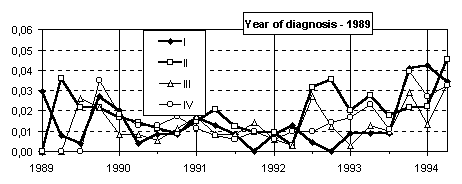
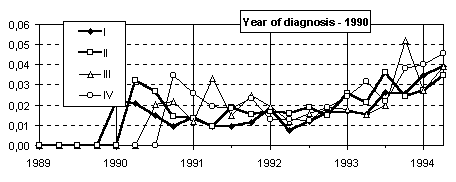
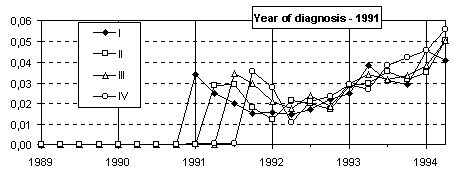
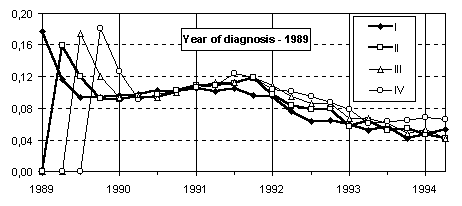
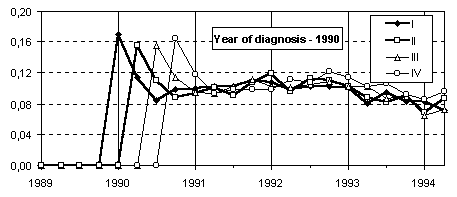
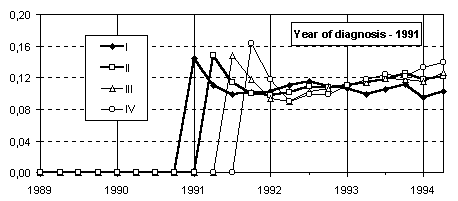
For the individuals whose condition was reclassified as AIDS only after implementation of the new definition in late 1992- beginning 1993 (doesn't meet earlier pre-1993 definitions), quarterly mortality rates are presented on Fig. 1 separately for years of diagnosis 1989, 1990, and 1991. Each curve represents dynamics of mortality since the quarter of diagnosis to the second quarter 1994. The quitters of diagnosis are indicated in the bars for each year of diagnosis. Location of the year-of- death labels at the horizontal axis corresponds to the first quarter of the year. For the sake of comparative analysis, dynamics of mortality rates have been also calculated in the same way for AIDS patients whose conditions met pre-1993 definition of AIDS at the date of diagnosis. Results are presented on Fig. 2.
Thus, Fig. 1 represents dynamics of mortality among the individuals whose condition was observed far before the new definition of AIDS had been implemented, and was not classified as AIDS at least until late 1992 - early 1993 (when the new definition was implemented). In other terms, individuals in this group were living without AIDS diagnosis for some period (up to late 1992 - early 1993), even though their condition met the new 1993 definition of AIDS all that time. In late 1992 - early 1993 they suddenly became "AIDS-patients" -- due to new definition alone. On the other hand, Fig. 2 represents dynamics of mortality among the individuals whose cases were classified as AIDS just at the date of diagnosis and meet the earlier (pre-1993) definitions of AIDS. In other words, individuals in the second group were "AIDS patients" since the very date when their condition was diagnosed first, and had not been affected by reclassification.
Discussion
Mortality rates tend to decrease during first 2-4 quarters after the date of diagnosis in both groups (see Fig. 1,2). Then, in the second group, the rates stabilize for a period of about 1.5-2 years (see Fig. 2). This period of relatively constant mortality in this group is followed by further decline (see Fig. 2). Thus, mortality of the individuals who had been "AIDS patients" since the very date of diagnosis demonstrate general trend to decline with a lapse of time.
The individuals in the first group (whose condition met only the new 1993 definition of AIDS and was classified as AIDS only later, when the new definition was implemented), also demonstrate downward trend in mortality rates, at least until late 1992 - beginning 1993 (see Fig. 1). But since the third-forth quarter 1992, mortality rates started to grow steadily irrespective to the date of diagnosis. The later is a very essential feature: this growth of mortality is associated not with time elapsed after the date of diagnosis but with the date itself (see Fig. 1). This means that some factor(s) started to affect this group in late 1992 - beginning 1993, and, then, continued to exert its influence all the time after (at least by the end of the period of analysis -- June 1994).
What is the factor which increased mortality in these individuals and began to influence the group in late 1992 - beginning 1993? Just that time the new expanded definition of AIDS came into being and changed abruptly status of these individuals from "HIV-positives" to "AIDS-patients". There are at least two consequences of such a change. First, the individuals either were put on medication by drugs with severe side effects or such treatment was intensified (for individuals who had already been put on such medication). Second, the very information about AIDS diagnosis results in severe and permanent psychological stress. Such a stress is known to compromise general health as well as the immune system itself.
A question should be answered. The new definition of AIDS was published by the CDC only in December 1992 [2]. Why did the increase in mortality became noticeable 1-2 quitters earlier that date? It seems obvious that publication of the new definition of AIDS had been preceded by some period when the decision was ripening in medical circles. During this period, more and more physicians were prone to consider decline of counts of T4- lymphocytes in HIV-positives (just the essence of the new definition of AIDS) as a sign of developing full blown AIDS. This forced them to start or intensify medication by the drugs normally used to treat AIDS patients (these drugs known to have severe side effects).
It is a very alarming trait in the dynamics of mortality that the upward trend demonstrates no tendency to saturation (at least by the end of the period of analysis -- June 1994). The increase in mortality after pure change of status from "HIV- positive" to "AIDS-patient" had been 3-5 fold during a period less than 2 years. At the same time, during this period, mortality rates go down steadily in the second group, even though the rates are about 5-6 times higher as in the first group. Individuals in the second group were not affected by reclassification from "HIV-positive" to "AIDS-patient" in late 1992 - early 1993 (because their condition meets pre-1993 definition of AIDS).
Analysis of the updated CDC's data set, which includes deaths registered in 1995 as well as more precise data on deaths occurred in 1994, would have been very useful to establish further trend of mortality in the group of individuals reclassified as AIDS-patients only due to the new definition. It is worth noting that at least two attempts of the author of this paper to obtain the new 1995 version of the data set [1] from the CDC have been unsuccessful, as well as attempts of at least two AIDS-skeptics (citizens of the USA) whom he asked to order the data set. It makes the author suspect that the CDC are, probably, aware about the facts described above (quite unpalatable for mainstream AIDS research and medicine), and try to conceal the truth by some manipulation with data, or at least to impede the truth-finding process carried out by independent researchers.*
y = mortallity rate (per quarter)
x = date of death (quarter)Fig. 1 Dynamics of quarterly mortality rates in individuals diagnosed retrospectively as AIDS. At the date when their condition was first registered (date of diagnosis), the condition did not meet definition(s) of AIDS accepted at that time, and became "AIDS" only with expansion of the definition in late 1992 - early 1993. (Year-of-death labels at horizontal axes correspond to the first quarter of the year)
y = mortallity rate (per quarter)
x = date of death (quarter)Fig. 2 Dynamics of mortality rates in individuals whose condition meets earlier (pre-1993) definitions of AIDS. These individuals have had status "AIDS-patient" since the very date of diagnosis.
Here you find a zipped Exel file with Fig.'s 1 & 2 and used data.
REFERENCES1. Centers for Disease Control. AIDS Public Information Data Set. Data through December 1994 (7 disks + 31 pages manual)
2. Centers for Disease Control. Morbidity and Mortality Weekly Report, Recommendations and Reports, December 18, 1992